Friday, February 22, 2013

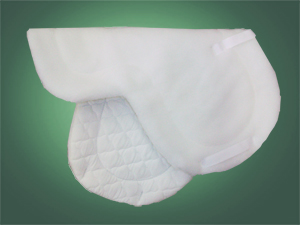
Where to Find Shaped Pads That Fit

It can be difficult to find a shaped saddle pad for hunter or equitation classes that fits your saddle perfectly, showing an even border that isn't too narrow or too wide all the way around the saddle. Some companies make saddle pads in different shapes and sizes in order to help you find the best fit, so this post will give you an idea of the different companies that offer such options. If you can't shop for a pad in person to try it with your saddle before you buy, some companies can give you an idea of which model might work best with your brand and size of saddle if you contact them.

You might have noticed that I don't normally mention particular brands in this blog, mostly because I don't want to give anyone the impression that the myth of judges caring about brands holds any merit (as long as your clothing and equipment are well-fitted, clean and appropriate, the only people who might care about trends are your fellow competitors). In this case we are using brand names because correctly-fitting pads can be difficult to find and there aren't many companies that offer enough options to fit a variety of saddles. These companies aren't necessarily trendy; they're seen on the show grounds because they offer saddle pads that fit well.

If you know of a company that should be included in this list but isn't, either leave me a comment or send me an e-mail and I'll add it!

The approximate price ranges given here are in American dollars and could vary from store to store.

Price Guide
$ = under $40
$$ = $40 to $69.99
$$$ = $70 to $99.99
$$$$ = $100 or more

Wilker's: More shapes available than you would imagine, some even for particular brands, all in a wide variety of sizes.
Prices: $ to $$

Toklat: Several different styles with a couple of brand-specific options, each in a variety of sizes.
Prices: $$

Ecogold: Both forward and regular flaps in a variety of sizes, along with specialty pads.
Prices: $$$$

Ogilvy Equestrian: Great customer service, with different sizes offered and a memory foam option, but currently only available in sheepskin rather than synthetic fleece. Rumour has it that they will come out with a new synthetic fleece model at some point.
Prices: $$$$

Fleeceworks: A limited number of different shapes along with a small range of sizes, all in sheepskin.
Prices: $$$$


EquineLUX: Non-slip high-tech pads. Come in three sizes with a sizing chart to get an idea of the fit, and I'm told that they will also make customized pads to your saddle's measurements at no extra charge.
Prices: $$$$


Saturday, February 16, 2013

How to Dress for a Jumping Clinic

Clinics can be a fantastic way to get off the property while at the same time getting coaching from another set of eyes. Turning your horse out well for a clinic is a way of showing respect for the clinician, so this post will cover the ideal turnout for both informal and very formal clinics.

The best way to find out what is expected in terms of turnout for a particular clinic is to contact the organizer. If formal turnout is expected, they are likely to mention it at some point in the communication prior to the clinic. For most clinics, informal turnout should suffice as full formal turnout is usually only seen for a select few clinics with certain world-class clinicians.

Informal Turnout

My general rule of thumb is that the horse and rider shouldn't look out of place in a mid-week jumper class. That means that everything should be neat and tidy and fairly conservative, but without braiding or wearing a show jacket.


For warm-weather clinics, the rider should wear a tucked-in polo shirt, beige breeches (or breeches of a similarly light colour), belt, polished field boots and a helmet. Many riders will also wear gloves, and hair should be neatly contained as you would wear it at a show. If you must use paddock boots and half chaps instead of field boots, make sure that they are clean and polished.

In cooler weather, a fitted sweater can be added, and for even colder weather, a fitted jacket. Baggy clothing is not acceptable when the clinician needs to be able to see you ride! In extremely cold weather, the use of winter riding breeches or boots would certainly be understood even though these sometimes do not come in show colours or finishes. Riding in a clinic will usually warm you up quickly, so wearing layers that can easily be removed is ideal.

The horse should be as clean as possible, including any white markings. The mane should be neat and shortened (braid it over before the clinic if it tends to be messy) and the tail fully brushed out. The hooves can be oiled and the face and legs should be trimmed. In cold weather, a full show clip is not necessary. The saddle pad can be either square or shaped, but should be white, black or another conservative colour. The tack should all be just as clean as it would be for a horse show, and you can start with the set-up that you feel most comfortable in, aside from any devices like draw reins that do not belong at a clinic. Try to bring a few extra bits, spurs and martingales with you in case the clinician wishes for you to try something different. You should also carry a crop unless your horse cannot be ridden with one.

Formal Turnout

Formal turnout is essentially what you might show in on the weekend, adding in braiding and a show shirt and jacket. Again, this type of turnout is not common for jumping clinics (99.9% of the time you'll be fine with the informal turnout) so ask the organizer if you suspect that it might be expected.


Formal turnout should follow the same general rules as informal turnout except for braiding the mane and wearing a show jacket instead of a polo shirt . I would expect to see a hunter in a fitted pad with hunter braids while the jumper can wear a conservative square pad with either hunter or jumper braids.

The horse should also have a full body clip in cold weather for this sort of clinic. The odds are that if the horse is entered in such a high-level clinic, it will be worked hard enough at home to warrant the full clip, anyway.


Monday, February 11, 2013

How to Hang a Hay Net

Hay nets are often used while trailering to allow the horses to eat during the trip, or while at shows to keep hay in front of a difficult keeper. There are risks involved, however, with the large hoof-sized holes and the general ability of horses to get themselves into trouble, so hanging them safely is very important.

The easiest way to fill a hay net is to stretch the opening over the end of a bale rather than trying to wrestle individual flakes into the net one at a time. Once the net is full, pulling the drawstring closes the opening. Rather than wrestling with knots, the easiest way to keep the net shut is to pull the drawstring so that the knot sits against the rings of the hay net, holding them together. This also ensures that the knot will stay out of the way when you hang the net up.


Step two is to find somewhere to hang the net. Horse trailers often have welded loops set high in the trailer that are perfect for this purpose. In some cases, the bars on the trailer window have to suffice. In a stall, a hay net can be hung from a high bar (temporary show stalls usually have a bar that runs all the way around the top of the stall that is ideal for this) or through a screw-eye set high on a wooden wall. It's important to hang it from a high enough spot so that the bottom of the hay net will remain well out of reach of the horse's legs. Safety-wise, it's better to tie a hay net too high than too low. Aiming for wither-height or higher when hung should be safe. Once you have found a suitable spot, run the drawstring around the bar or through the loop and then pull the hay net up as high as it will go (it will slip down slightly as you tie it).


Keeping tension on the drawstring so that the hay net stays up, pull it down and hook it around a string near the bottom of the hay net. Pull the drawstring back up towards the top of the hay net, bringing the lower part of the net up with it.


Loop it back through the upper section of draw string...


 ...and tie a quick release knot to secure the hay net.


Flip the net around so that the quick release knot lies against the wall, away from the horse so that it is less likely to be accidentally untied by teeth.


This last photo illustrates why it's so important to double up the hay net by hooking the drawstring around a bottom string while hanging the net. As you add hay, the string diamonds that make up the net become wider, making the whole net shorter. As it empties, the diamonds end up with less and less width, making them longer until all of the string is hanging vertically when empty, making the net almost twice as long as when it's full. The doubled hay net will stay up high even when it's empty, while a non-doubled net hung at the same height will produce something like this red net, hanging dangerously close to the ground (both nets are the same size!):


Saturday, January 26, 2013

Turnout Critique #10

This week's featured rider clearly makes a very good effort towards her turnout, resulting in a nice, workmanlike pair. A few minor changes could improve their turnout further to make them really shine.


All of this horse's tack appears to be well-fitted, with every piece showing the deep shine of clean, well-conditioned leather. I'm not a big fan of breastplates on hunters; I find them to be mildly distracting. They are legal if they are made entirely of leather, but I wonder if a well-fitted saddle would really move very much anyway in an under saddle class without one.

I don't like to see a hanging bridle tag on a hunter; I much prefer a discreet name plate, which can even be placed on a cheek piece so that it can be covered by a strap. If the hanging tag is not easily removable, I have had success tucking them out of the way between the cheek piece straps between the buckle and the top keeper after bridling the horse.

The saddle pad is nicely chosen to fit this saddle. I find the excess stirrup leather to be on the verge of being too long, so I would tuck it under the saddle flap.

The hooves are nicely oiled and the small amount of white on the legs has clearly been cleaned and shows just a small amount of show ring dirt.

What worries me is how dull this horse's coat is, given the shine on the rider's boots and tack and how much effort this rider puts towards their turnout. I expect a healthy horse who receives a lot of elbow grease to have a deep shine as a result. If this horse is healthy as far as can be told, and shows no signs of ulcers, adding some oil to the feed in the form of flax, black oil sunflower seeds or vegetable oil could make a big difference to the shine of the coat.

The mane is nicely braided and tidy. The tail is thin and doesn't fall like a tail that has been thoroughly brushed from bottom to top shortly before heading to the show ring. This horse could also benefit from a fake tail to balance out his proportions.

I can't tell whether the horse's open mouth is simply an atypical moment in time or if he goes like this frequently. If the mouth gapes frequently, a dental check-up and/or change of bit might be of benefit.

The rider is very well-dressed with a classic navy jacket that fits well through the body, clean beige breeches and very shiny field boots, with spotless soles. This is the reason for having someone at the ring with a towel following your warm-up; when the entire boot is clean with no dirt or horse slobber, it brings everything together. The outfit is completed with conservative black gloves and a black helmet, and a lovely demonstration of neat hunter hair.

Overall, I really appreciate the effort that this rider has made and I'm sure that the judges notice it, too. They will be especially eye-catching when her horse matches her level of shine.

Thank you very much to this week's featured rider for submitting this photo! Anyone interested in participating in a future Turnout Critique can send any photos to showringreadyblog@gmail.com

Thursday, January 17, 2013

Turnout Critique #9

In this week's Turnout Critique we'll be looking at a horse who looks more ready for the dressage ring than the hunter ring. Some details are difficult to see through the photo quality, so some aspects of the critique will be fairly general.


The number one change that needs to happen to transform this horse into a hunter is to switch to a shaped saddle pad instead of a square pad. This would bring them in line with the hunter rules.

This horse looks like he's well groomed with his deep, shiny liver chestnut coat. His mane and tail appear to be brushed out very nicely with no clumping, but a hunter's mane really should be braided. Some riders like to keep their horse's mane long for breed standards or based on personal horse-keeping practices. If you are serious about showing in the hunters, however, pulling or shortening the mane will bring your turnout in line with what is expected. At the schooling level, a running braid done tightly against the crest of the neck will make a full-length mane look neat and similar from a distance to those done in traditional hunter braids, while keeping the rider's hands from getting caught in the mane over fences. There is a lovely example of a tight running braid here (under "French Braid"). The tail looks like it might be braided, which is a nice touch for the bigger classes.

This horse is not wearing any boots or bandages, leaving the legs naked as is appropriate for a hunter class.

The bridle is all leather of a similar colour, which is good, but a raised noseband and browband would complement the horse's head more than the plain, flat leather. Raising the noseband to within an inch or two of the cheek bone would bring the proportions of the head into balance, making it look less long and more refined. Trimming some of the facial hair would also help to refine the head. The straps should also be kept in their keepers. If the keeper is too big and the strap comes out in the show ring, adding a braiding elastic beside the keeper can help to keep the strap in place. As far as I can tell, the reins are laced leather, which is appropriate for the hunter ring. The D-ring bit is also very appropriate.

It's a good idea to check the stirrup leathers for evenness every so often because they can get stretched to different degrees. It might just be that that the horse was posed in such a way that they only appear uneven in the photo, but I suspect that they would not be of equal length if the horse was halted square.


As far as the rider goes, the classic combination of navy jacket, white shirt and beige breeches is a good one. The jacket is a bit too baggy; a more fitted body would look more polished. Even the shirt seems large in the neck area. Brass buttons aren't usually seen in the hunter ring since buttons that match the jacket colour are more conservative. The black gloves are a very good choice with this outfit.

I'm not sure whether this helmet doesn't fit properly or simply has been pushed back by the rider. A helmet should be worn so that the base of the front of the helmet lies parallel to the ground. In other words, looking at a rider face-on, the bottom of the helmet should make a straight line across the forehead instead of a line that's curved upwards. This is done both for safety and aesthetic reasons. In addition, the helmet strap is hanging down, which can be corrected with the addition of a black braiding elastic on the strap.

The final step is to clean and polish the boots. Even the soles are dirty, a problem that can be solved by having someone use a brush or towel to clean them after you get on. Always polish your boots before a horse show as it's one of those things that is very noticeable if not done. It's easy to remove dust and slobber from well-polished boots with a towel at the in-gate to bring out their full shine.

Overall, this is a cute horse who would really shine in the show ring with just a little bit more work to even out the whole picture.

Thank you to this week's featured rider for submitting these photos! Anyone wishing to be featured in a future Turnout Critique can send any photos to showringreadyblog@gmail.com


Sunday, January 6, 2013

Turnout Critique #8

This is our first jumper Turnout Critique. Jumpers are more difficult to critique because so much is allowed that it really comes down to personal taste. I, personally, like a very clean and fairly conservative turnout for jumpers, and this critique will reflect that. As long as your turnout falls within the rules, however, it will not affect the judging of a jumper class. I believe that good turnout still shows respect for the judge and the horse show and I therefore like to make the effort.


The first thing that strikes me is how nice and clean this very cute pony is! The ends of her tail could be a little bit whiter, which usually comes from shampooing the tail frequently well ahead of the horse show, but as far as I can tell without knowing this horse's coat markings and assuming that the orange jump is reflecting off the back legs, especially after looking at all of the photos, I think that this rider has done a good job with her grey horse.

I would like to see the tail brushed out better, starting from the bottom and working all the way up to the top so that it doesn't fall into clumps as we see here. The mane could be pulled and/or shortened to make it neater and less likely to catch the rider's hands during a release. I like to braid jumpers' manes for big classes, but an unbraided mane is perfectly acceptable, and the norm, for a casual class.

Hoof polish would add a nice finish to the turnout, especially in contrast to the light coat.

The bridle appears to be well-fitted to this pony and I like the conservative fly veil. My preference is for a conservative base colour for a fly veil, and then personality can be added through coloured trim if desired. A true white fly veil can make even a clean horse look yellow, so the best colours to use on a grey are usually (depending on the lightness of the grey horse) off-white, grey or black.

I am not a big fan of this patterned saddle pad for showing; I think that a plain white pad or a white pad edged in black, or even a black pad edged in white for a casual class, would look very clean and professional while suiting the overall colour scheme.

The saddle looks like it might benefit from a good conditioning (although it might just be a trick of the light) and I would tuck the excess stirrup leather under the saddle flap so that it isn't flying around. As I've mentioned in previous posts, it's a good idea to keep an eye on the peacock irons over time as some aren't meant to take the weight of more than a young child. I would prefer to see a girth that is closer in colour to the saddle and bridle.


This rider's helmet is fairly conservative and appropriate for the jumper ring. Her hair appears to be neatly contained in a braid, which is perfectly acceptable for long hair, although putting it up inside the helmet is the neatest option.

If it's warm enough to show in short sleeves, my preference would be to remove the bulky vest before entering the ring. My personal practice is to wear a thin V-neck sweater over a polo shirt on cooler days so that the collar of the polo still shows and the lightweight fabric means that you're less likely to overheat once you start riding. The V-neck makes it easy to pull over your helmet if you get too warm and want to take it off.

This rider is not wearing gloves, which is perfectly acceptable if that is how she prefers to ride. If she ever wants more protection for her hands, she should choose black, brown, or even beige gloves depending on the rest of her outfit to remain conservative.

The breeches are an appropriate beige colour and are clean. Her boots, however, are a different story! If the light colour on the toes is dirt, they should have been cleaned before the horse show and preferably again after mounting. If it's discolouration from wear, the boots should have been buffed with black polish. I like for a rider's boots to be polished at all times in the jumper ring. Also, when half chaps are used, they should ideally be the type that look like tall boots from a distance, and they should be polished as well.


Overall, I think that this rider has done a very good job of presenting herself for a schooling-level jumper show. It will only take a few minor changes and polishing to bring their turnout up to the next level.

Thank you to this week's featured rider for submitting these photos! Anyone wishing to be featured in a future Turnout Critique should e-mail any photos to showringreadyblog@gmail.com

Sunday, December 30, 2012

Turnout Critique #7

In this Turnout Critique, we'll be taking another look at a horse and rider who we've seen before at their very first horse show. Now we'll be looking at their turnout for the cold season.


Clipping might not be an option for certain horses depending on their living conditions (indoors vs. outdoors, blanketing, etc.) and workload. If you choose to show in the colder months without clipping, you need to go a step further with your turnout to show the judge that you haven't simply pulled your horse out of the field and onto the trailer. In this particular case, the step further would be to braid, even for a schooling show. The messy mane and forelock add to the overall hairiness and make it look as though all of the effort has gone towards the rider rather than the horse. Braiding at least the mane would demonstrate that an effort has been made. The hooves should similarly be polished as a finishing touch.

It's difficult to tell based on these photos alone whether the tail is dirty or simply has dark colouring. Even in cold weather, it's possible to partially wash the tail without making the horse wet by using a clean, damp sponge. Spread the tail across your knee and wipe each section down with the sponge until it comes away clean (rinse the sponge when it gets dirty). You could even use shampoo on the sponge if you're careful to rinse it away with another sponge afterwards. Using this method, it's possible to get quite a clean tail that can be easily brushed out, even in the winter!

Trimming the whiskers would also help to refine the turnout, but some riders do prefer to keep them, especially in the off-season.

While the feathers look like they started off clean and white, which is great, long hair does tend to capture dirt and you can see in the bottom photo that they did not stay white. If you do not wish to trim the leg hair, you can bring a stiff brush to the ring to remove most of the dirt from the warm-up and then apply baby powder or corn starch to the white socks to further whiten them.

If the coat is long, it will usually form a wavy pattern as the horse sweats. If you are showing a horse with a winter coat or whose summer coat has not finished coming in, bring a hard brush to the ring and run it over the horse right before entering the show ring to remove that waviness, making the horse appear sleeker and neater.


This bridle is not acceptable for the hunter ring, with its contrasting padding on the noseband and browband. The bridle should be brown or black with no accents of any other colours. I also wonder whether these reins are leather; I can't zoom in closely enough to confirm but they strike me as possibly being rubber or webbed, which would be illegal in the hunter ring.

The saddle pad is very clean and fits the shape of this saddle as well as can be expected, given the saddle's all purpose shape. Further down the line, this rider might think of switching to a proper jumping saddle that would help her to maintain the position and balance desired for the hunter ring. Her peacock irons are acceptable for a junior rider but I suggest that she keeps an eye on them as she grows as many brands are not designed to take an adult's weight. The excess stirrup leather is short enough that it is acceptable as is, but if it were any longer I would suggest either folding it under the saddle flap or trimming it.


I prefer the fit of this jacket to the one that we saw this rider in last time; it is slightly more fitted at the waist and through the arms. Paired with a clean white shirt and beige breeches, it is a classic combination that always works. The black crop is also appropriately conservative, and the clean black leather gloves add a polished subtlety to the hands.

From what I can see from these angles, the rider's hair appears to be appropriately neat and contained.

Several inches of the helmet strap hang down, and this is distracting. If it does not stay in the original harness set-up, I suggest trying to add a black braiding elastic or something similar to keep that excess strap contained.

The black field boots are very well-fitted, but they should always be polished before a horse show. It's the small details like polishing boots and hooves that really bring turnout to the next level.

I suggest that this rider practices braiding before her next show. That, combined with a change of bridle and a bit of polish, will make a big difference to her turnout, especially if she develops some special routines just for winter shows. 

Thank you very much to this week's featured rider for submitting these photos!

If you would like to submit one or more photos for a future Turnout Critique, send them to showringreadyblog@gmail.com