Wednesday, June 18, 2014

Fixing an Equine Bad Hair Day

With horses being horses, the only time when you are likely to see a large section of rumpled hair on your horse will be on a show morning. Depending on how your horse lies down overnight, the hair can get bent backwards and if it stays that way, you'll be faced with a fuzzy-looking patch of hair that won't brush back to straightness. Left as is, this will detract from the sleek, shiny coat that you've worked so hard to produce for the show ring.

Thankfully, the solution is easy, though it needs to be done early enough to give the hair time to dry before your classes.

Like human hair, horse hair reverts to straightness when it's wet. The solution, therefore, is to wet the hair, brush it straight and then brush it again once it has dried (a really bad case might benefit from an additional brushing or two while it's still a bit damp).

If you've ever tried wetting the hair and haven't found any improvement, odds are that you didn't wet it thoroughly enough. The hair needs to be soaked down to the skin, coating the entire shaft, so it requires either a sponge that hasn't been wrung out, or a bath. If you have a grey horse, rumpled hair shouldn't be a problem because your morning bathing routine should easily take care of it. If your horse doesn't require a full bath, just take a clean sponge saturated with clean water and really scrub it into the area.

Once the hair is wet, brush the hair straight with a stiff brush. The stiffness will allow the bristles of the brush to reach down to the entire length of the hair. Depending on the severity of the bent hair, you might need to brush it straight again a few times while it's drying and then give it a final smoothing out once it has dried fully.

If you're in a hurry to get to your class you can spray some rubbing alcohol onto the wet spot to help speed up the drying process. If you're in no rush, the alcohol is unnecessary and is likely to do more harm than good by drying out the hair and skin.

If the bent hair is a result of the horse rubbing against the wall or a bucket, the hair can be more damaged than it would have been from the horse simply lying down on it, and it might therefore require the wetting process to be repeated to bring the hair back to its former straightness.


Wednesday, June 4, 2014

Review: Equine Omega Complete

The more we learn about nutrition, the more complicated it seems to become to feed our horses in the best possible way. In recent years, the importance of the correct ratio of omega-3 to omega-6 has become more recognized, and many of the foods traditionally fed to show horses contain far too much of the bad omega-6 fatty acids.

There is evidence for omega-3 fatty acids having an anti-inflammatory effect1, which is beneficial for sport horses. Omega-6s, on the other hand, have an inflammatory effect. Studies have shown that a diet high in omega-3 fatty acids has a beneficial effect for arthritic horses2.

A grass-based diet provides a higher amount of omega-3 than does a grain-based diet3. For show horses who spend most of their time in stalls, and especially those who are fed a lot of grain, adding as little extra omega-6 as possible is important to maintain the best ratio of omega-3 to omega-6.

Traditional fat supplements for horses tend to be extremely high in omega-6s (corn oil is in the region of 1:58 omega-3 to omega-6, and sunflower seeds contain almost exclusively omega-6). Flax seeds and flaxseed oil are essentially the only traditional fat source for horses containing more omega-3 than omega-6.

Vegetable sources such as flax contain short-chain omega-3 fatty acids, while fish oil contains long-chain versions. The body is not very efficient at converting short-chain omega-3 fatty acids to the more desirable long-chain ones, so feeding fish oil allows the long-chain fatty acids to be given directly in the most desirable form.

For all of these reasons, I was very interested to try Equine Omega Complete when I was asked to review it. Equine Omega Complete contains mechanically-expelled soybean oil, human-grade deepwater fish oil, 3000 IU of Vitamin E per daily dose and all eight essential amino acids. I chose two different horses with different needs to see what a month's worth of Equine Omega Complete could do.

Horse A, a thoroughbred, is a fairly difficult keeper who always has a shiny coat but tends to have dry skin, and she is very particular about what she eats. Horse B, a warmblood, will generally eat anything, and suffered this spring from a dull coat.

My initial concern was whether or not the horses would even eat something containing fish oil. I was shocked when my picky eater ate an entire daily dose of Equine Omega Complete in just a small amount of grain without hesitation! The second horse enjoys his Equine Omega Complete so much that he will eat an entire daily dose out of his feed tub with no grain at all. Both horses became more vocal than usual at dinner time while they were on the supplement and clearly enjoyed eating it.

The top photo shows Horse A's weight
on day 1 of Equine Omega Complete,
while the bottom photo shows her
condition after finishing a month of
Equine Omega Complete and
after three weeks of horse shows!
The supplement is very easy to use and my supply came with a convenient measuring cup to give an accurate daily dose. I tried feeding it all at once as well as splitting it into two doses per day, and didn't find much of a difference in terms of results or feed tub leftovers between the two methods. I did find that this supplement didn't pour quite as cleanly (it is quite thick) as other oils that I've used, but the person responsible for feeding the second horse didn't find hers messy so perhaps it depends on your pouring technique. I'm told that Equine Omega Complete now comes with a pump and I suspect that makes it even easier and cleaner to administer.

As far as results go, horse A finished the month shinier than she has ever been, more than she ever was on ground flax or black oil sunflower seeds. While her skin is still on the dry side, it doesn't seem as flaky as it used to be and she has held her weight far better than she usually would through the first few shows of the year.

Horse B has finally developed the deep shine to his coat that has been elusive all year until now.

Neither horse seemed to get "hot" while on the supplement.

It would have been interesting to see whether there were any other improvements visible over a longer period, but over the short term I think that the supplement did all that it could be expected to do. You can read about all of the potential benefits at www.o3animalhealth.com

The only real downside to the product is that it is more expensive than many of the more commonly-used (but high omega-6) oils, but from what I can tell it is similarly-priced to flaxseed oil.

If you are looking for a complete oil supplement to feed to your horse, I would certainly recommend Equine Omega Complete for consideration. While I don't like to promote any one product as a "must have", I can say that it seems to do what it's intended to do and would be a very good option.

Another great thing about Equine Omega Complete is that they give away a free bottle of product every month on their website! Head over there and enter your e-mail address for a chance to win!

Disclosure: I have received no financial compensation for writing this review aside from a sample or copy of the product to be reviewed. My reviews are always my honest opinion and experience. Readers who use reviewed products do so at their own risk.


Monday, June 2, 2014

Young Horse Boots

I have heard of some eliminations as a result of riders not being aware of the new boot rule for young horse classes, so here's everything you need to know if you plan on competing in a young horse class run under FEI rules:

FEI Article 257.2.4

For all international Young Horses Competitions (five *, six, seven and eight year old Horses): All hind leg protections must have a maximum interior length of 16 centimetres; the width of the fastener must be at least five centimeters (refer to FEI Jumping Stewards’ Manual on the FEI website for diagram).

 * NB: Competitions for five year old Horses may only be held at the FEI World Breeding Jumping Championships for Young Horses, unless special authorisation has been granted by the FEI.

The following criteria must be respected in relation to hind boots worn in international Young Horses Competitions (see also the FEI Jumping Stewards Manual on the FEI website):

The inside of the protection must be smooth. Only non-elastic Velcro-type fasteners are permitted; no hooks, buckles, clips or other methods of attaching the fasteners may be used;

The rounded rigid part of the protection must be placed around the inside of the fetlock;

No additional elements may be used in conjunction with the protection.


Here is a page from the Stewards Manual showing examples:


The gist of the rule is that hind boots mustn't have elastic, must have only wide velcro closures, and mustn't have any protrusions on the inside (smoothness refers to a lack of protrusions rather than to a specific type of material, as far as I am aware).

This rule, designed for the welfare of the horse, aims to reduce the practice of over-tightening boots to increase sensitivity and the use of boots designed to exaggerate the movement of the hind end over fences by applying pressure. 

There are not many brands of boots that currently fit these criteria. I am currently aware only of the Young Jump boots made by Veredus that are definitely allowed and will update this post with any others that I come across. There are several basic neoprene types of boots that should fall within the guidelines, but it's best to check in person before purchasing to make sure that there is no elastic on the straps.


Tuesday, April 29, 2014

Hair Net Choices

As more hair net options become available, it can be difficult to know which one to choose without buying and trying them all. Hair nets marketed towards riders are generally thicker and more durable than ordinary hair nets that you might find elsewhere. There are currently three different types of equestrian hair nets (excluding "show bows", which are a big no-no in the hunter/jumper world!), each with their advantages and disadvantages. No type is perfect (unless you're not at all sensitive to knot pressure), so cost, comfort and ease of use need to be weighed against one another while making a choice.

Colour-wise, you should pick one that is closest to your hair colour as the goal is not to have the hair net itself stand out. If there is no exact match, a hairnet that is slightly lighter or darker that your hair colour is not likely to attract attention.

Two-Knot Hair Nets


Two-knot hair nets are the most traditional, they are easy to find and they tend to be the cheapest option available. Having two knots gathering the material makes for a hair net that is essentially the same shape all the way around to keep the hair fairly well-contained without any looser areas to puff out from under the helmet. They are available in a variety of colours to match most hair colours.

Advantages:

  • Inexpensive
  • Available in practically every tack shop
  • Even stretch all the way around
  • Available in a variety of colours

Disadvantages:

  • Knots can cause pressure points under a helmet
  • Don't contain hair well once the net has stretched

One-Knot Hair Nets


One knot hair nets are similar to the two-knot ones but have the advantage of one less pressure point, so you can choose a neutral location to position the knot at. Because of that, however, all the material is gathered at just one end, which creates a more baggy shape, especially as the weave loosens with wear.

Advantages:

  • Single knot can be placed where it won't cause a pressure point
  • Relatively inexpensive

Disadvantages:

  • Single knot causes the shape to be more baggy even before any stretching occurs

No-Knot Hair Nets


No knot hair nets are the newest on the equestrian market, and essentially consist of a wide band that goes around the head, leaving it open on top. They hold the hair tightest and make it easier to style the hair by holding everything in place against the head. For some, using a hair elastic might not even be necessary and they come with a handy storage pouch to keep them away from things like velcro and shavings that can ruin hairnets. Colour choice is the weakness here, with the colours either very light or very dark, and the packaging appears to be a bit misleading colour-wise.
A no-knot hairnet in its pouch (this
is the so-called "medium-brown")

Advantages:

  • No pressure points
  • Seemingly more robust netting
  • Holds hair more closely against the head 
  • Allows the hair to be put up without having to lean over
  • Comes with protective bag to help it last longer

Disadvantages:

  • Comparatively much more expensive
  • The band fits more tightly than the band of a traditional hair net
  • Colour options are limited (good for either very light or very dark hair)
  • Opaque packaging makes it difficult to find the correct colour
  • The band is fairly wide, which could make it blend in to your hair less easily


Thursday, April 10, 2014

Turnout Critique #13

This week's Turnout Critique is interesting because we have photos from a couple of different shows, showing the horse at two different levels of turnout and at two different body conditions.


This rider strikes me as someone who has recently had a growth spurt because while all of her apparel appears to have been chosen with care, several elements are too short. The jacket, while a good dark colour, appears too short, with the waist sitting too high and the bottom not coming far down enough. A good rule of thumb is that the bottom hem at the back of the jacket should just barely brush the seat of the saddle. The field boots are several inches too short and as a result they have dropped below the bottom of the rider's knee. Boots that are too short break up the lines of the leg and can give the illusion of strange proportions. For equitation classes in particular, care should be taken to choose boots that are not too short. When purchasing new boots, plan for them to drop an inch or two (which means that they will feel uncomfortably high on the knee at first).

The upper part of the boot is clean and well-polished, but the foot area appears dull. Unless the ground is so wet that it washes the polish away, polished boots should redevelop their shine after being wiped down. Care should be taken to ensure that the entire boot is polished before showing (and be aware that some leather conditioners can dull the finish and make it difficult for the boots to hold a shine). For an equitation class (which this appears to be), a small spur, even if it is a "dummy" spur, would help to draw the judge's eye to the nicely lowered heel.

This rider's hair is neatly contained in a conservative helmet and hairnet, and she could bring some hair down over her ears to complete the full "hunter hair" look.

She appears to be wearing a belt with her tucked-in show shirt, as is appropriate, and the breeches are well-chosen for their colour and fit, and are clean. Her black gloves are also well-chosen to complete the outfit.


Another reason why it appears that this rider might have had a recent growth spurt is that the saddle seems to be too small, both in the seat and the flap. You should be able to fit about a hand's width between the cantle and your seat, and the flap is almost entirely hidden by the rider's leg. I recommend that this rider work with her trainer and a good saddle fitter to evaluate whether it's time to move to a larger saddle. This does not have to be a huge expense because good quality saddles can be found used for much less than they would cost new.

This rider pointed out herself that the saddle pad is too large, but if the saddle needs to be replaced, the pad might actually end up being the correct size. The outline of the saddle pad, to me, matches the rider's leg better than the flap of the saddle does.

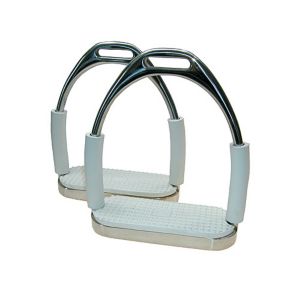
The excess stirrup leather is too long for my taste; I find this to be distracting particularly as a horse canters around, causing it to flap up and down. I would either trim the stirrup leathers so that the ends just extend past the edge of the saddle pad, or tuck the ends under the flap to visually shorten them. The silver-coloured stirrup irons are the correct choice for the equitation ring.

This horse is wearing leather boots, which are appropriate for equitation classes. If this horse were to enter a hunter class, the boots would need to be removed.

The bridle appears to be well-fitted and all of the tack seems to be clean and in good repair.

The horse is nicely braided and appears to have his face trimmed. His tail is sparse and to bring his turnout to the next level, I would try a fake tail when braiding to fill it out a little bit and balance his outline. I'm impressed by the turnout of all of the horses seen in these photos; for a local circuit final, these riders are doing a great job with their overall presentation.

The horse's coat is dull and he is lacking weight. In a case like this, I would seek advice from a vet in case the cause is something health-related such as worms or ulcers. If the horse is deemed to be healthy and just needs more weight, I would try adding oil to the feed for extra calories and to add some shine to the coat.


This final photo was taken some time later, after the horse had gained weight. In my opinion, he could still benefit from gaining a few more pounds and his coat is still on the dull side, so I would continue to lean towards adding oil to the feed if all else has been ruled out and the horse is being deeply groomed on a daily basis.

This time the horse is not braided, but he does have a pulled mane. While I'm told that this was just a local county show, I would still be tempted to braid the mane. Not only is it a good opportunity to practice your braiding skills where slightly less-than-perfect braids won't stand out, but when the horse is looking a bit rough temporarily yet is still capable of showing, putting those extra touches on the turnout is a way of making up for the dull coat or slight thinness. We also know that the peanut gallery will often be quick to criticize without knowing the full story, so putting added effort into the horse's turnout when there are minor issues that you can't control can be a way of expressing that you do care about your horse.  

Most of my comments from the earlier photos also apply to this one. The rider is now wearing spurs, which improve the look of her leg, but she should either trim the straps or tuck them in so that the ends don't hang down so low. The horse's tail looks fuller, either because it has grown out or because it is unbraided. It could probably use an extra brushing out before tacking up to make sure that the strands don't clump together.

When doing "hunter hair", this rider should make sure that some hair comes down to cover the tops of her ears along with the hairnet. In this photo, only the hairnet is over the ear, which creates a line splitting her ear in two.

The horse's white socks look fairly dirty despite the footing not appearing to be very wet, so I would suggest clipping the socks in the future to help keep them clean. Applying baby powder would also help to whiten the socks the day of the show.

Thank you very much to our featured rider for submitting these photos. She's doing a great job and with time and a wardrobe that better suits her height, she and her horse should look like winners. 

If you are interested in being featured in a future Turnout Critique, please send your photos to showringreadyblog@gmail.com

Wednesday, March 26, 2014

Equitation Stirrup Rule Update

When the new stirrup rule was announced for equitation riders, there were many unanswered questions regarding what exactly was meant by the rule and how judges would interpret it. Now that the rule has been in effect for a few months, some more information is starting to emerge. There is still confusion and the rules seem to be interpreted differently between Canada and the United States, but at least there are now some clues available.

The American rule is worded as follows:

EQ110 Appointments
4. The use of stirrups that have entirely black branches is not permitted in any Equitation class. The use of stirrups which have entirely black branches will automatically result in elimination.

The Canadian rule reads:

ARTICLE G1005 TACK AND EQUIPMENT
5. [...] Only silver-coloured stirrups are permitted in equitation or 
medal classes. Use of black or coloured stirrups will incur elimination.*

The American rule is clear on the point that stirrups with small amounts of black on them, such as stainless steel jointed stirrup irons with black joints, are permitted. This has been confirmed by Dover Saddlery, who received this statement from Lauren Fahey, the Director of Hunter Affiliates, USEF: "The rule will apply to stirrups that are entirely black, such as the composite stirrups sometimes used in show jumping. Stirrups with black rubber on the branches that cover a portion of the stainless steel will still be allowed for use in equitation when the new rule takes effect."

There have been reports of judges in the US eliminating riders for stirrup irons that they consider to be too dark, however, even if the stirrups are not actually black. This has occurred with composite stirrups that were marketed as a good choice for the equitation ring. The safest choice is therefore to either spray paint composite stirrups silver if only dark products are available, or to use a silver-coloured aluminum stirrup or traditional stainless steel stirrup iron (jointed or regular).

In Canada, while the competition season has yet to get into full swing (leaving us waiting to hear how the rule will actually be implemented at shows), apparently the Equine Canada Rules Committee has said that stainless steel stirrup irons with black joints will not be permitted in equitation classes at EC shows. Peacock-style safety stirrups with black elastics will still be permitted

It is not clear whether jointed stirrups with grey joints will be permitted, but I suspect that they will be allowed since the colour is close to silver and the rule is not worded against using jointed stirrups in the equitation ring.

To summarize:

For US equitation classes:
- You may not use stirrups with branches that are entirely black
- You may use silver jointed stirrup irons with black joints
- You risk elimination if you use composite stirrups that are not black, but still dark in colour

For Canadian equitation classes:
- You may not use stirrups that are not silver in colour
- You may not use silver jointed stirrup irons with black joints
- Any colour other than silver, even if metallic, puts you at risk of elimination

*Update to the update:

Jump Canada has released a clarification to make the rule more specific.

G1005.5 will now read:
"Stirrup irons must not be affixed to the rider's foot or boot in any manner. To facilitate the judge's view of the rider's foot position, black or coloured stirrups (other than silver/grey) or stirrups with black or coloured branches are not permitted and, if used, will incur elimination."

G1102.3 will now read:
"To facilitate the judge's view of the rider's foot position, black or coloured stirrups (other than silver/grey) or stirrups with black or coloured branches are not permitted and, if used, will incur elimination."

So grey joints are definitely permissible in Canada, which was also confirmed to me by someone in the know. The rule is still not completely clear on black joints, but I would continue to avoid them based on previous comments from Equine Canada. 


Friday, February 21, 2014

Turnout Critique #12

The first Turnout Critique submission of 2014 is a lovely example of good hunter turnout, with only a handful of minor improvements that could be made.


This horse is in good condition and is groomed thoroughly on a regular basis, as evidenced by the deep shine of his coat. If anything, he might be a little bit too fat, but jumping photos can sometimes be deceiving in that respect. He appears to be quite hot and sweaty, and could possibly benefit from being clipped if this show did not take place on an unusually hot day. The braids are nicely done as far as the photo shows.

All of the white markings have clearly been meticulously cleaned, and this good work would be highlighted by a fresh application of hoof oil to the feet.

The tack all appears to be properly fitted, clean and in good repair. The noseband would flatter the face better if it were put up a hole or two so that it sits just one finger's width below the cheekbone. We are often fooled into judging the size of the head by the length from the browband to the noseband, so the noseband should be kept up near the cheekbones to minimize this distance (bridles stretch over time, therefore this should be checked every so often).

The saddle pad is just the right shape for this saddle, with a very acceptable 1 1/2 inches of pad showing all the way around the edges. The excess length of stirrup leather is just short enough to be tidy without needing to be tucked or trimmed. The tack is a great example of not needing to have everything in the exact same colour. The saddle and girth match, making neither stand out to the eye. The martingale and bridle are darker in colour, but since they are on a separate part of the horse and are in a similar colour family to the saddle, nothing stands out as being different.

This rider is beautifully dressed in well-fitted beige breeches, belt, dark jacket, white show shirt with the now-common wrap collar and conservative black gloves. Her hair is neatly contained in the hunter style and she sports an appropriately conservative helmet by today's standards. My only problem is with her boots, which don't show the high shine of a pair that have been recently polished. She could also ask a groom to brush off the bottoms of her boots after she mounts for a cleaner look. The boots appear to be made of a thin, supple leather, which produces a lovely slim profile but could also require extra time spent polishing due to the leather's more porous surface.

The quality of this horse and rider combination is so high that any turnout faults are very minor. This rider appears to be a great example of someone who puts a strong effort into presenting herself well in front of the judges.

Many thanks to this week's featured rider for putting herself forward for a critique!

Any readers who are interested in being featured in a future edition of Turnout Critique can send photos to showringreadyblog@gmail.com