
Hunters/Equitation
The Equine Canada rule for dress is as follows:
ARTICLE G109 DRESS
1. All competitors must be properly dressed in the confines of the arena. This includes the inspection of the course and at the presentation of prizes.
2. Competitors should be neatly and suitably dressed in coat, shirt and tie, choker or stock, breeches or jodhpurs and boots. Black or brown smooth leather half chaps are permissible providing they match the boot colour.
... Only approved helmets (see Article G102) of a conservative color are allowed.
3. If competitors are not suitably dressed, the judge may refuse to allow them to compete.
4. In hunter competitions, in extremely hot weather, coats are optional at the discretion of the Competition Committee.
...
6. At all EC-sanctioned competitions, anyone mounted on a horse must wear the required headgear (see Article G102.1) as well as safe, appropriate footwear.
The key for hunters is to dress conservatively and neatly.
Helmet
The helmets for men are the same as those for women.
Hair
Men are lucky that they don't have to worry about doing "hunter hair". Try to keep your hair cut short enough that it doesn't hang too far out of your helmet and that's about it!
Show shirt
Show shirts for men are the same as regular dress shirts, although a select few companies do market show shirts to men with special features for riding. Ideally, opt for a shirt with long sleeves as the lack of a cuff on short-sleeved shirts can give you an unfinished look. You can choose whatever colour you want for your shirt but make sure that it doesn't clash with your jacket. The most common colours are white and pastels. When you want a formal look, go with a white shirt.
You will need to wear a tie, and for a regular hunter class, the colour of tie is up to you. Conservative is again the key word. For a hunter classic or derby, full formal attire calls for a white shirt with a white tie. Make sure that your tie won't escape your jacket and distract the judge during your round.
Show jacket
There are show jackets made specifically for men, and these should be worn rather than a men's suit jacket because they are designed to be ridden in and are cut appropriately to accommodate sitting in the saddle. The colour is up to you, provided it is conservative, but navy is a very safe classic choice and the buttons should match the jacket colour for the hunter and equitation rings. For a hunter classic or derby, the colour should be dark, ideally navy or black.
Number
Your number is to be worn around your waist the same as for women.
Breeches
There are breeches sold specifically for men, usually designed with more of a relaxed fit than you see in women's breeches. Breeches should be light in colour. Beige (or greenish beige) is appropriate for showing in the hunter ring. White breeches can be worn by men in hunter classics or derbies when full formal attire is called for, but are not appropriate at other times.
Boots

Male hunter riders should wear men's field boots. These are the boots with laces in front, as shown in this photo. There is no way to go wrong with black leather. Be sure to polish your boots to a shine before you show.
Leather half chaps worn with matching paddock boots are allowed but field boots are the better choice.
Spurs
Spurs may be worn but they are not mandatory. Spur straps should be clean and match your boots. There are spurs made for men that are wider to accommodate the width of men's boots.
Gloves
Gloves are not mandatory, either, but they do look much better than bare hands. Black gloves are ideal, but brown gloves can be appropriate if they match the rest of your outfit. White gloves are never appropriate in the hunter ring since the rider is not meant to stand out. Again, there are gloves made specifically for men's hands.
Jumpers
Here are the EC attire rules relating to jumpers that were not mentioned earlier:
ARTICLE G109 DRESS
2. [...] Note that breeches and boots (not half chaps or paddock boots) are mandatory in FEI Children's Jumping classes. Only approved helmets (see Article G102) of a conservative color are allowed.
5. In jumper competitions, in extremely hot weather, riders may, at the discretion of the Competition Committee, be permitted to wear dress or riding shirts with or without chokers and ties or open-neck polo shirts without jackets; no sweatshirts, t-shirts, tank tops or other similar dress will be permitted. Shirts must be neatly tucked into riding breeches.
Formal attire
How often you will have to wear formal attire will depend on the individual horse show. Generally speaking, polo shirts are acceptable on weekdays and formal attire (jackets and dress shirts/ties) is required on weekends. It is up to each show to set their own standards for formal attire, however, so some shows will only require jackets on Sundays while others require jackets beginning on Fridays, for example. If you're not sure what to do, ask either the in-gate person or someone at the show office.
Also keep in mind that some classes will require a jacket even when the rest of the classes in the day do not. This usually applies to big-money welcome classes early in the week and jumper equitation classes.
If you wish to look your best at all times, you are free to wear a jacket on informal days even if the other competitors choose not to.
Helmet
Again, helmets are unisex and anything ASTM-approved (check your federation's rules for country-specific requirements) will do.
Hair
While ideally your hair will be kept short enough not to look messy outside of your helmet, you may do whatever you want with it.
Jacket
You can choose any colour or style for your show jacket and again, there are show jackets made for men.
Show shirt
Once again, any colour goes and you can just wear a regular dress shirt. You are free to stand out as much as you would like from your competitors with your shirt and tie, but try to choose a colour that doesn't clash with the rest of your outfit. For formal classes, white is the most appropriate choice, along with a white tie. Ensure that your tie is secured in such a way that it won't fly up during your round.
Polo shirt
If you are allowed to wear a regular polo shirt, it must be tucked into your breeches and it should be one solid colour. No other shirt, apart from a dress shirt, is appropriate as a substitute.
Breeches
Breeches may technically be of any colour, but 99.9% of riders in regular jumper classes will wear beige (or greenish-beige) breeches. Grey breeches are sometimes seen in weekday classes and white breeches are seen in formal classes.
White breeches are generally considered to be "earned" by competing at a certain level. Wearing them before that time can be a bit of a faux-pas. White breeches generally only begin to be worn by the majority of riders at around the 1.20m level and above. If you are competing below that level, beige breeches are the more appropriate choice unless the trend is different in your area.
Boots
Men's field boots are again best choice for the jumper ring, but you are allowed to wear other tall boots such as dress boots instead. You may also wear leather half chaps with paddock boots, but this is not the dressiest choice.
Boots should be cleaned and polished before you enter the ring.
Spurs
Spurs are optional and should be humane in nature, and are again available in men's sizes (make sure that the straps you choose are also in a men's or long size).
Gloves
Gloves are optional as well. If you choose to wear them, a dark colour looks best.

Show shirt
Show shirts for men are the same as regular dress shirts, although a select few companies do market show shirts to men with special features for riding. Ideally, opt for a shirt with long sleeves as the lack of a cuff on short-sleeved shirts can give you an unfinished look. You can choose whatever colour you want for your shirt but make sure that it doesn't clash with your jacket. The most common colours are white and pastels. When you want a formal look, go with a white shirt.
You will need to wear a tie, and for a regular hunter class, the colour of tie is up to you. Conservative is again the key word. For a hunter classic or derby, full formal attire calls for a white shirt with a white tie. Make sure that your tie won't escape your jacket and distract the judge during your round.
Show jacket
There are show jackets made specifically for men, and these should be worn rather than a men's suit jacket because they are designed to be ridden in and are cut appropriately to accommodate sitting in the saddle. The colour is up to you, provided it is conservative, but navy is a very safe classic choice and the buttons should match the jacket colour for the hunter and equitation rings. For a hunter classic or derby, the colour should be dark, ideally navy or black.
Number
Your number is to be worn around your waist the same as for women.
Breeches
There are breeches sold specifically for men, usually designed with more of a relaxed fit than you see in women's breeches. Breeches should be light in colour. Beige (or greenish beige) is appropriate for showing in the hunter ring. White breeches can be worn by men in hunter classics or derbies when full formal attire is called for, but are not appropriate at other times.
Boots
Male hunter riders should wear men's field boots. These are the boots with laces in front, as shown in this photo. There is no way to go wrong with black leather. Be sure to polish your boots to a shine before you show.
Leather half chaps worn with matching paddock boots are allowed but field boots are the better choice.
Spurs
Spurs may be worn but they are not mandatory. Spur straps should be clean and match your boots. There are spurs made for men that are wider to accommodate the width of men's boots.
Gloves
Gloves are not mandatory, either, but they do look much better than bare hands. Black gloves are ideal, but brown gloves can be appropriate if they match the rest of your outfit. White gloves are never appropriate in the hunter ring since the rider is not meant to stand out. Again, there are gloves made specifically for men's hands.
Jumpers
Here are the EC attire rules relating to jumpers that were not mentioned earlier:
ARTICLE G109 DRESS
2. [...] Note that breeches and boots (not half chaps or paddock boots) are mandatory in FEI Children's Jumping classes. Only approved helmets (see Article G102) of a conservative color are allowed.
5. In jumper competitions, in extremely hot weather, riders may, at the discretion of the Competition Committee, be permitted to wear dress or riding shirts with or without chokers and ties or open-neck polo shirts without jackets; no sweatshirts, t-shirts, tank tops or other similar dress will be permitted. Shirts must be neatly tucked into riding breeches.
 |
| Richard Spooner demonstrating correct formal attire for the jumper ring |
How often you will have to wear formal attire will depend on the individual horse show. Generally speaking, polo shirts are acceptable on weekdays and formal attire (jackets and dress shirts/ties) is required on weekends. It is up to each show to set their own standards for formal attire, however, so some shows will only require jackets on Sundays while others require jackets beginning on Fridays, for example. If you're not sure what to do, ask either the in-gate person or someone at the show office.
Also keep in mind that some classes will require a jacket even when the rest of the classes in the day do not. This usually applies to big-money welcome classes early in the week and jumper equitation classes.
If you wish to look your best at all times, you are free to wear a jacket on informal days even if the other competitors choose not to.
Helmet
Again, helmets are unisex and anything ASTM-approved (check your federation's rules for country-specific requirements) will do.
 |
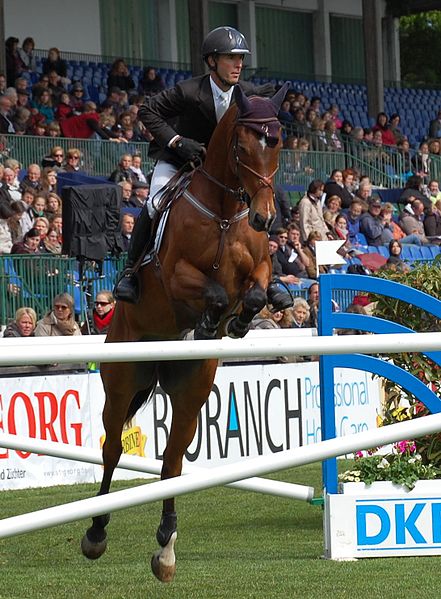
| Steve Guerdat looking very neat and tidy |
While ideally your hair will be kept short enough not to look messy outside of your helmet, you may do whatever you want with it.
Jacket
You can choose any colour or style for your show jacket and again, there are show jackets made for men.
Show shirt
Once again, any colour goes and you can just wear a regular dress shirt. You are free to stand out as much as you would like from your competitors with your shirt and tie, but try to choose a colour that doesn't clash with the rest of your outfit. For formal classes, white is the most appropriate choice, along with a white tie. Ensure that your tie is secured in such a way that it won't fly up during your round.
Polo shirt
If you are allowed to wear a regular polo shirt, it must be tucked into your breeches and it should be one solid colour. No other shirt, apart from a dress shirt, is appropriate as a substitute.
Breeches
Breeches may technically be of any colour, but 99.9% of riders in regular jumper classes will wear beige (or greenish-beige) breeches. Grey breeches are sometimes seen in weekday classes and white breeches are seen in formal classes.
White breeches are generally considered to be "earned" by competing at a certain level. Wearing them before that time can be a bit of a faux-pas. White breeches generally only begin to be worn by the majority of riders at around the 1.20m level and above. If you are competing below that level, beige breeches are the more appropriate choice unless the trend is different in your area.
Boots
Men's field boots are again best choice for the jumper ring, but you are allowed to wear other tall boots such as dress boots instead. You may also wear leather half chaps with paddock boots, but this is not the dressiest choice.
Boots should be cleaned and polished before you enter the ring.
Spurs
Spurs are optional and should be humane in nature, and are again available in men's sizes (make sure that the straps you choose are also in a men's or long size).
Gloves
Gloves are optional as well. If you choose to wear them, a dark colour looks best.


